Death Whispers but Summit Commands
Gautam DuttaCategory: Article
Date of Publication: Aug 20 , 2026
I think about that day quite often. However, it doesn't send a shiver down my spine anymore like it used to. It felt as if I had seen death with my own eyes that day. Standing right in front of certain death, I can still clearly remember the realization that comes over a person. I managed to cross the boundary line between life and death that day. Remembering that incident, Brig D. K. Khullar (the leader of the Indian Pre-Everest Expedition in 1982, and later the leader of the fourth and second successful Indian Everest Expedition via Nepal in 1984) called my survival a Miraculous Escape in his writing.
"........ We had Gautam Dutta, who fell 500 feet while descending to Camp II after climbing the summit (Kabrudome - 21,776ft.). He was unroped; his rope having been used up to fix route. It was a miracle that he survived and that too with no injury........"—Indian Mountaineer No. 11.
I know very well that it was indeed a Miracle! That fall remains etched in my memory—the sudden slip, the helpless plunge, the icy slope rushing upward, and the strange calm that followed. I remember thinking, so this is how death feels! Yet life held me back, as if the mountain itself refused to let me go.
A person might walk up and down the stairs of his house for years, only to fall from them one day and die. Just consider the case of Ms. Charlotte Fox, the first American woman to summit seven 8,000‑meter peaks, and survivor of the 1996 Everest disaster, who tragically died on May 24, 2018, at age 61 after falling down a staircase in her home in Telluride, Colorado. In fact, such incidents happened even at my locality years earlier. But before the Kabrudome incident, I never knew it was possible for someone to fall more than 500 feet down the steep wall of a 21,776-feet-high mountain and come back completely unharmed!
Mountaineering is inseparably bound with the thought of death. Every climber knows that each step may lead toward the unknown, yet the call of the mountains remains irresistible. The awareness of mortality does not weaken the spirit—it deepens it. In the silence of the heights, death ceases to be a fear; it becomes a companion that teaches humility and courage.
It was September 26, 1982. The time was around 4.00 to 4:30 in the afternoon. Evening shadows were starting to mix with the daylight. Sunset was still a little way off, at least according to the clock.
The night before, at around 2:00am, we had left the safety of our Summit Camp (6096m/20000ft) tents. We were four, divided ourselves between two ropes. Lobsang and Nima were on one rope, while Mahavir and I were on the other. A few other climbers were to follow behind us in two more ropes. They left the camp a little later. Among them was a female climber, Umeshwari Devi from Manipur. The job for the four of us on the first two ropes was to move ahead from the Summit Camp and set up a route to summit. In stead of a direct route along the wall, we shifted little eastward from the middle of the wall and took a diagonal path across it, finally leading to the peak through a rugged and tortuous ridge. Of course, fixing ropes along the entire wall was absolutely necessary. The climbers coming behind us would use these ropes for support and safety.
Just by looking at it, as we reached the middle of the steep ice wall, it wasn't hard to realise that our rope was going to run short. We needed at least a few hundred feet more rope. Extra rope had been brought along, but it had already been used up to secure the Summit Camp itself. The spot of the camp was a very precarious place. Three small tents were pitched on a shelf that had been painstakingly carved out of the ice wall. Each tent was anchored to a fixed rope that descended from above. For ease of entry and exit, a fixed rope was lowered from the front of each tent so that, while coming out or getting in the tent, one could immediately anchor to the rope using a Jumar. Otherwise, a single slip meant plunging hundreds of feet below. Even, all of us had to respond to our nature’s call hanging on to the fixed rope just in front of our tents keeping the tent’s door-flap covered. There was simply no other way! Technical precision became our lifeline. Fixing ropes across treacherous shelves, anchoring pitons, and ascending with jumars required absolute focus. A misplaced crampon or a loose anchor could mean disaster. The mountain tolerated no error. Thankfully, no mishap occurred.
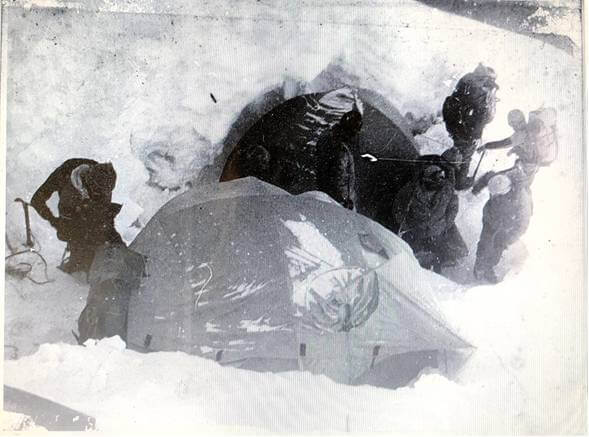
The summit camp at 20000ft(6096m) in a very critical place established on 22.09.1982 by the advance-team.
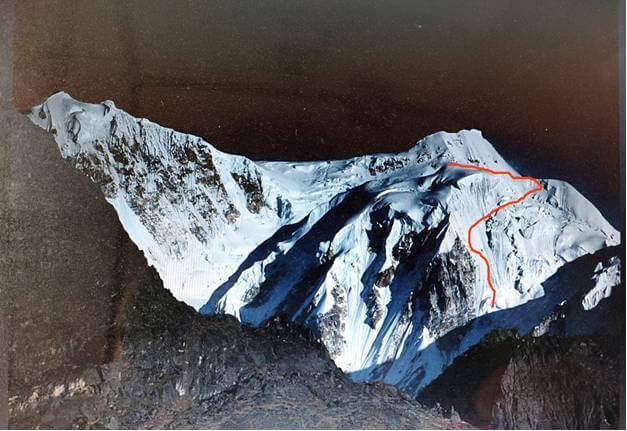
The wall beyond the summit camp; with the route made by us shown in red line.
The wall, on the whole, was very steep and the final ridge was jagged and winding. We chose not to fix any rope along a certain section midway up the wall, ensuring we wouldn't run out of rope as we approached the very top and be forced to turn back. We worked tirelessly, climbing and traversing wall and then securing ridges in freezing winds and blinding snow. Supplies were scarce, and fatigue gnawed at the edges of consciousness. Yet the determination to reach the summit burned brighter than the fear of anything else enroute. And, breaking through all the barriers, we four, finally reached the summit at about 1:00pm.
I carried a Zeiss Ikon range finder camera. Took some shots. Nima, felt interested to take a shot through the same, and took a shot keeping other three of us on the summit (attached herewith below).
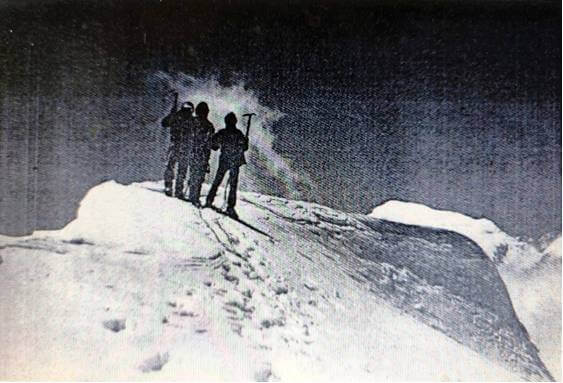
On Mt. Kabrudome(21,776 ft): From L to R -Lobsang, Mahavir and Gautam – Photo by Nima.
(The peak was first summited on 26.09.1982 by: Lobsang Shering, Nima Wangchu, Mahavir Thakur, and Gautam Dutta at 1:00pm (noon); then at about 2:00pm summit was reached by P. T. Bhutia, Ms Umeshwari Devi, and Shering Dorjee. Later, on September 28th, around 11:00am, R.S. Sandhu, Manik Banerjee, B.S. Rai, Parbati Prasad Gautam, and Ki Kami reached the summit.)
About an hour later, three climbers including Umeshwari also arrived the summit. But, as the fourth team couldn’t reach even at 3:00pm, we were anxious and forced to begin our descent. After climbing down a bit and reaching the corner of the curved, bow-like ridge of the summit, where from we were to step on the wall again, we spotted them below. There were three people in that rope — A. Kalita from Assam, K N Singh from Rajasthan, and the third was Bidyut Sarkar from West Bengal. We discussed amongst ourselves and considering time-constraints decided to tell them not to proceed further. Accordingly, I shouted down from above, telling them not to proceed any further because it would make it incredibly difficult for them to return down safely. If we couldn't make it back to the tents by evening, it could be life-threatening. But the allure of reaching the summit is intensely strong. They did not listen to the warning and kept moving forward. We, on the other hand, kept descending.
When we finally came face-to-face with them, they had almost reached the end of that middle section where no ropes were fixed. When they realized during our face-to-face conversation that it was no longer wise to proceed, the phase of everyone descending together began. Each climber moved like a shadow, guided only by instinct and the faint glimmer of snow under the dying light. The silence was immense, broken only by the crunch of crampons and the whisper of the wind. Lobsang, Nima, Mahavir, and I began helping everyone down safely. Shri Bidyut Sarkar, also known as 'Chhorda' (the name he was widely known by in the mountaineering community), was 41 years old at that time. I learned my initial lessons in mountaineering from him. It was he who had sparked an interest deep within me, forging a deep bond of love for the mountains and the rugged outdoors. He has always held a place of immense respect deep in my heart. He was the eldest among the climbers present. Naturally, I stepped down a bit below him and began helping him descend. Perhaps he didn't really need it, and he never openly asked for my help either. Even so, I felt, it was my duty.
During the descent, some other people were also slipping. After discussing it with Mahavir, I untied the rope that served as our only link. Using that rope, Mahavir provided a belay (a rope fed from above as needed) from the top, to whoever needed it, while I, without a rope, took up a position just below them. I was especially careful about Chhorda, to watch over him and ensure he didn't face any trouble.
I was descending with caution. This act could be called a technical error in mountaineering activities. Of course, I have done such things many times. I have always been eager to take a little extra risk (often unnecessarily). I feel a greater thrill climbing steep walls without the help of the "lifeline" called a rope. This is not right. It is a bad habit. It is not that I did not understand that, but like an addiction, such situations would take hold of me.
As I sit here writing today, I remember how Chhorda punished me while I was taking my primary lessons in rock climbing to nip this habit in the bud—and that, too, in front of 70-75 pairs of eyes. The punishment was quite heavy: hundred push-ups after eating a full lunch. Though he stopped me after I performed twenty, tears welled up in my eyes that day. The reason for the punishment was that after finishing all the climbs assigned for the day according to the rock-climbing training curriculum, while Chhorda was busy with others, I, ignoring the need for any rope assistance, climbed up a steep wall and sat on top of it, hoping that it was unseen by everyone. The wall must have been at most forty feet high. I wanted to finish that climb without anyone noticing by looking around once, but I could not escape Chhorda’s gaze. He was busy training on a wall some distance away. Even amidst the busyness, he perhaps realized that I was doing something against the rules. After reaching the top of that wall and getting to a safe place, I looked down and saw Chhorda standing right at the base. He made me realize through his gaze that I had committed a huge offense. With a gesture, he called two other instructors over there and pointed me out to them. With just one sentence, he scared the life out of me that day. Right then, he announced his decision to the other instructors—"Keep this boy in mind; he needs special punishment." Perhaps to make me understand the gravity of the offense, he ordered me to do push-ups on a full stomach. I did not understand the importance of this punishment that day; I understood it later.
The south-east face of Kabrudome. The sun had already dipped below the ridges, and the day waned into dusk, the melting snow grew wet beneath our boots, clumping into heavy snowballs within the grips of our crampons. By rule, before every step, this has to be broken with the help of an ice-axe, and I was doing just that. Only once, yes, just once, a mistake happened. The moment I was about to strike with the ice-axe to break the lump of snow stuck under my foot, at that very moment, Chhorda was about to slip. I tried to drive my ice-axe into the ice of the wall under Chhorda’s foot, instead of striking my own foot, so that Chhorda’s foot would get anchored. In doing so, I had to front-point near my knee with my right foot, which had the snow lump stuck to it. The result of this was terrible. My right foot, due to the lump of wet snow stuck underneath it, slipped. Before I could anchor myself by plunging my right hand's ice-axe into the ice, I lost my balance and tumbled down.
I fought with everything within me to self-arrest with the axe. I failed. My body spun wildly like a tetherless top, plunging downward. The wind roared past my ears—a harsh, rushing symphony. In that terrifying blur, I could sense that my certain death was only a few moments away. The fall took a little time. Amidst it all, I remembered my loved ones, three faces—my mother, my father; and for a fleeting moment, that face flashed right before me which takes refuge in my mind the instant it is out of sight. I had absolutely nothing left to do. Whirring, screaming, rushing wind! The sound of the fierce wind's velocity rushing past my ears. Spinning in dizzying spirals, my body hurtled lower, and lower, and lower still.
The capacity of each brain cell is immense. In such a state, they seem to become even more active. A series of multiple flashbacks, one after another, yet a complete absence of pain within myself. Because I had to accept death, there was no grief or any such feeling. In reality, no matter how short the actual duration of the fall is, due to the brain's alertness at that time, it feels like quite a long period. At least, that is how it felt to me. That day, I realized firsthand that every single second is a collection of many, many moments. As I kept falling further down, I felt as if I was becoming weightless. Along with the feelings of resistance-free ease, weightlessness, and so on, I was actually quite active in my consciousness. Suddenly, I realized that my body, falling flat on its back, had lost touch with the surface of the wall at high speed. I was no longer there; my body was floating in the air. Mentally, I prepared myself for the ultimate outcome of the very next moment. That final moment, I suppose, was very brief. A massive impact! My mind spun around. I became senseless. The whooshing, the roaring—everything ended. After that, I knew nothing. My body remained driven deep into the relatively hard, packed snow, having pierced through the loose, powdery snow cover on top, facing toward Nepal.
Later, I deeply thought a lot on the issue and two things repeatedly surfaced in my mind regarding death:
1. The situation of timelessness, when someone is at the verge of death; otherwise, how could one be able to visualize his/her entire life in so small physical time, as I have experienced; and,
2. The situation of painlessness, since the moment one accepts death; which I clearly felt!
How long I lay without sense or soul, I do not know.
Gradually, awareness stirred. From somewhere far off, familiar voices drifted through the quiet—Mahavir and Lobsang calling my name in endless, desperate shouts. Their cries summoned a faint flicker of consciousness within me, yet I remained submerged in a heavy stupor. My mind could hold no thought; memory slipped like sand through my fingers, and I sank back into the dark again.
I know not how much time was lost in that void before the veil lifted once more. Softly, carried on a passing breeze, distant human voices drifted down, bringing with them a strange, tender wave of peace.
It felt like walking through the blinding, parched glare of a midday summer across an endless, scorching plain—finally reaching the solitary shade of a small, leafy tree. As you collapse beneath its boughs, heart bursting with thirst and exhaustion, your eyes heavy with sleep, the lonely cry of a soaring kite far up in the sky sounds like a whisper reaching across the abyss of eternity. It fills the heart with instantaneous bliss.
With great effort, I managed to open my eyes slightly. I saw a massive drift of carded cotton-like clouds, with fragmented patches of blue sky peeking through the gaps. A quiet question surfaced in my mind: Where am I?
Slowly, memory returned. Just a few hours ago, I had stood atop the summit of Kabrudome (21,776 ft) on the border of West Sikkim and Nepal—a climber in the 1982 pre-Everest expedition, with the seductive lure of Everest waiting just ahead, vying for a place in the 1984 Indian Everest Expedition via Nepal.
Now, I lay flat on my back, buried deep beneath a mantle of soft snow. Directly above me, I could see nothing but the movement of clouds that resembled a thick fog, with only an occasional sliver line on the skirt of them against a backdrop of blue sky. It felt as though I were trapped at the bottom of a vast, white ocean. Alone. Utterly alone.
Why did this happen? How did I come to be here?
Bit by bit, the truth reconstructed itself. But I had lost all sense of direction. Through the dense fog, urgent, breathless words broke the silence—Mahavir and others calling my name once more, shouting to one another in solemn consensus:
“O mar gaya hoga…” — He must be dead.
I could not blame them. They had watched my body plummet at terrifying speed until I plunged out of sight. Stunned into silence, they had witnessed a falling object hurtling down for what felt like an eternity. Though they knew a living soul was trapped inside that falling shape, there was nothing they could do but watch. I lacked the strength to answer their screaming calls, and receiving no sign of life, they naturally abandoned all hope.
In the thin, fragile air of extreme altitudes, surrounded by serene and heavy quiet, sound travels vast distances. Unbroken by obstacles, even ordinary speech carries far across the void. Their desperate cries served as a compass, guiding me toward where they stood.
I lay there, trying to fathom the simple fact of my own existence.
Suddenly, a massive fragment of cloud swept hurriedly from East to West, crossing into Nepal. The next sliver of cloud had not yet touched it. In that momentary rift, my eyes locked onto the sheer wall to my left. High above, traversing across its face, figures were descending. They appeared tiny, mere specks against the ice.
In my semi-conscious haze, I watched them stretch from small to large, then shrink again—blurring into shadows, then sharpening back into focus.
And that vision—that fragile sight of living men—became my elixir of life.
Slowly, I tried to sit up. I couldn't. I felt absolutely no strength in my waist. It felt as though my waist was broken, and the condition of my right leg was just as bad. I couldn't even feel the existence of my right leg.
Not finding any sensation, I tried again, but in vain! Have I become immobile, then? Suddenly, my eyes caught the golden glow of the sun reflecting off a sliver of white cloud drifting across the blue sky above. A surge of immense mental strength welled up inside me. “I must survive; I must survive by my own efforts. No one is going to come to save me.” The urge to live is a powerful thing; that is when a person grows truly desperate to stay alive.
My situation back then was precarious. I brought my two hands together only to find that my gloves were missing. The balaclava on my head had also been flung off somewhere. I remembered buying it the previous winter specifically because of my father. My snow goggles were gone too. Only a thin, five-millimeter diameter accessory cord (a thin rope) hung from my right hand, and even that was torn. It was with this cord that my ice-axe had been carefully secured to my right hand. Mountaineers consider the ice-axe to be their third leg. I had untied the knot of my lifeline (the rope by which mountaineers remain tethered to one another) with my own hands. My subsequent fall had snatched away the ice-axe, along with all the other essential gear that people use on ice out of sheer desperation to save their lives. I was alone. Completely alone. But by then, I had become desperate to live. Burying both hands deep into the loose powdery snow on either side, I struggled heavily and managed to prop myself up on my waist! No, my waist wasn’t broken. But my right leg was completely numb. Not crawled, almost swimmed to come out of that large hole created by the impact of my body’s landing there. Suddenly, about twenty-five to thirty feet away, I noticed the pick of my ice-axe peeking out near the edge of the carded-cotton-like snow shelf where my body had been caught. A rush of indomitable energy filled my mind—I absolutely must retrieve that axe.
Looking toward the wall, there were several large ice crevasses gaping wide open, at least four worth mentioning, looking as if they were waiting to swallow me up. This section of the wall had shaped itself into a small shelf, only to immediately disappear back into a sheer, seamless drop. Going straight down, it terminated at a glacier below. Further down lay Nepal. I was lying right along the Indo-Nepal border. Fresh snow, constantly sliding down from the top of the wall, had formed a large bump at the junction of the wall and the shelf. My body, falling at extreme speed, had launched right over that bump, clearing the intervening ice crevasses before finally burying itself into a mound of soft, carded-cotton-like snow. How my ice-axe managed to tear the cord from my hand and fly past me, I do not know. There would be plenty of time later to investigate the cause and effect. First, I must survive, then everything else! And to survive, I needed that axe above all else. Spreading both hands out and using my left leg to drag my right leg along, I kept crawling forward, taking erratic breaths. I absolutely must get that axe. At that moment, no other thoughts could crowd my mind. Once the axe was in my hand, I held onto it tightly and had to catch my breath for about two minutes. It felt as if I had found something extraordinary. After that, I didn't find the time to look back. I managed to cross those terrifying crevasses mostly by crawling. Gradually, the numbness in my right leg began to fade as well. I was surprised at myself to see that the leg was slowly working better.
When a person becomes desperate, they can achieve a great deal. Without anyone's help—indeed, extending a helping hand was impossible for anyone at that time—I began climbing again. Slowly, the fixed rope came closer to me. Exhaustion weighed on every limb, yet I pressed forward through the cold and the wind. The mountain demanded complete surrender—of strength, of fear, of self. By then darkness crept across the wall…... What a wonderful convergence. Just as I reached and touched that section of the fixed rope, Chhorda arrived there too; his position was only a few feet above mine. Detached as ever, Chhorda’s first and last words to me then were, "Hey, you're alive? We thought you were dead." Even though the statement was one hundred percent true, I felt deeply hurt that day. Even today, I haven't quite been able to get over it. At that moment, I think I desperately wanted a touch of affection from him.
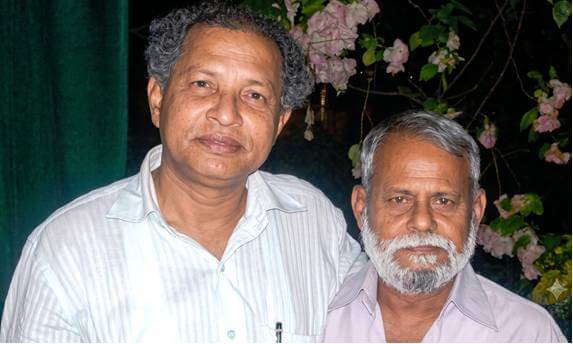
With Chhorda - A humble student with his great teacher.
To me, Chhorda is a man of immense stature, even though he is only about five feet two inches tall. And that is exactly why he is everyone's 'Chhorda'—and mine too. Just the previous year, in 1981, we had climbed multiple peaks together in the Nanda Devi Sanctuary area, in pure Alpine style, all of which were over twenty-two thousand feet in altitude. Though I led all the climbs there under his expedition-leadership, I have learned so much from him, perhaps I couldn't absorb it all. He will always remain my revered teacher. In fact, on that fateful day, there was no need for me to arrest Chhorda’s fall, because even if Chhorda had fallen, he would have been caught by the belay above, for which I have already given up my rope. Actually, I was too much emotion-driven for him!
I believe, the mountains reveal both human fragility and resilience. To climb is to confront mortality, but also to glimpse the grandeur of life itself. The peaks stand as silent teachers—majestic, indifferent, eternal. Standing before them, one feels both humbled and exalted. The confrontation with death becomes a meditation on existence. Survival itself feels like grace.
The next day, it was time to descend. Ratna De, a girl from Bengal, had become snow-blind. She couldn't see anything at all. She was crying out in pain like a small child…… Later, I once experienced the pain of someone suffering from snow-blindness by staring at the glare of arc welding for a long time, then rushing home to lie in bed groaning for two days—of course, I tested that in the safe comfort of my home just to understand the price a person has to pay when facing the same peril on a mountain…. We had to carry Ratna down. Lobsang, Mahavir, and I were on duty. Ratna was stuffed inside a large rucksack. Mahavir took it on his shoulders first, me beside him to assist hauling down the load and Lobsang was on belay. When Mahavir grew tired, it was Lobsang's turn to take the load on his shoulders while I took over the belay. After descending a bit, the exhausted Lobsang, with the help of the belay, anchored himself to the ice and lowered the rucksack from his back to catch his breath for a moment—it was time to swap turns. Suddenly, before the exhausted Lobsang could even realize what was happening, the rucksack with Ratna inside rolled down. Screaming out in horror, Mahavir and I, along with Lobsang, immediately glissaded down after it. Our high-speed glissade down that slope to catch Ratna could have invited a massive disaster that day. After rolling for about hundred feet or so, Ratna's body flew out of the rucksack and landed on the ice. A moment later, the sack also came to a halt. The three of us dashed frantically and climbing down to her, I stroked Ratna’s head and back, offering words of comfort as if nothing had happened. In response, there was nothing but the groaning of the blind Ratna. Lobsang, looking like a sinner, kept cursing himself. Ratna might have been lost to us that day. I haven't seen her in a long time; I have heard she is now employed in the teaching profession.
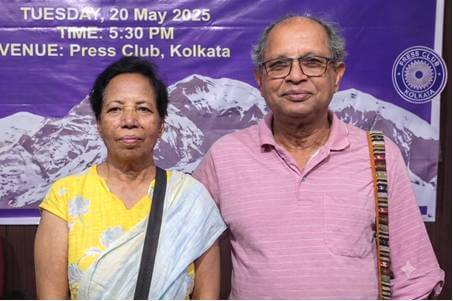
With Ratna(De) on 20.05.2025 - a meeting after more than 42 years.
The next day toward the afternoon, we reached the base camp. I cannot forget that great-hearted man. The moment we arrived at the base camp, Major Kiran Inder Kumar rushed forward, embraced me, and kissed my forehead as a reward for returning alive. In 1985, during the 5th Indian Everest Expedition via Nepal, he left us all behind, letting go of everything due to a mistake just like mine. Today, he is the Late Col. K. I. Kumar.
Many have left us. In 1981, Phu Dorjee passed away during the Nanda Devi expedition! During my mountaineering training days, his opinion regarding my potential had drawn many eyes toward me. Just before leaving for that expedition, I had met him at the Himalayan Mountaineering Institute in Darjeeling to wish him success. Around the same time, we were busy climbing Maiktoli (22,320 ft), Devtoli (22,270 ft), and Devimukut (22,120 ft) etc., via a new alpine-style route right opposite Nanda Devi in the Nanda Devi Sanctuary. Incidentally, that Nanda Devi expedition was led by Major K. I. Kumar. The cause of Phu Dorjee's death was also a "slip & fall." Pradipda (Pradip Das) passed away in 1982 itself. We had become very close through our shared love for mountaineering. Before getting the call-up for the Kabrudome expedition, I was selected to lead climbing on that very expedition to Rishi Pahar (Parvat). The other two teammates on the same rope as Pradipda did return from the clutches of death, both close friends of mine. Frostbite, however, did not spare them. Both had to sacrifice several fingers and toes. Satya (Satyajit Dey), my companion from the Advanced Mountaineering Course and a member of my own rope—he too is no more. Major Joy Bahuguna, my companion from the Mana South Face (Pre-Everest Expedition, 1983) expedition, along with three others, lost their lives during that same 5th Everest Expedition. Minu Mehta, another teammate from the Mana expedition and a close friend, has also passed away at Satopanth. Phu Dorjee (he and the Phu Dorjee of the 1981 Nanda Devi expedition are different individuals), one of the main heroes of the 4th Everest Expedition in 1984, a summiteer of Everest, and my companion on two pre-Everest expeditions, has also broken free from worldly ties. Ishwaran Bharatan of Delhi will never look back, even if called upon. In 1988, after our ascent of Mulkila (M-4), the highest peak in the Central Lahaul Himalayas and M-5, that is eight years after his (Ishwaran) death, we were forced to pull his body out of an ice crevasse only to bury it under the snow once again. Barun (Ganguly) will never return. Amitabh (Chakraborty) will not return either. Both of them were my companions at the winter pre-Everest expedition for the first Indian Everest Expedition via the North Face Great couloir route (China side), held in West Sikkim during peak-winter of 1990–91. However, Barun's death in my very arms remains one of the most tragic and unforgettable events of my life. Through his death, Barun taught me so many things. I have realised what great Tagore had depicted through his verses -
'Life and death are but servants of my feet (জীবনমৃত্যু পায়ের ভৃত্য)
I trample them down beneath my soles (পদতলে তারে দলি।).'
The storm of controversy surrounding Barun's death has traveled far. Barun's untimely death became a major factor in miring controversy while the first Indian Everest expedition via the China side was taking shape! But the poor soul! Perhaps he found peace in death, yet his devastated family—his widowed mother and brothers—got entangled in the traps of so-called regulations and have still received nothing as compensation from the life insurance scheme, even though this loss is irreplaceable. The organizing body of the expedition, however, did hand over fifty thousand rupees from their own fund to Barun's mother. Barun was a vibrant young man, my student at Advance Rock Climbing Course organised by Himalayan Association, and a great soul deeply dedicated to the mountains. There was immense potential within him. Harsh reality snatched him away from us, leaving his helpless, widowed mother's arms empty. It left his brothers mentally shattered, and the mountaineering community lost a valuable asset. Sher Singh, my partner in Chirbas Parbat’s first ascent, also left us on Mt. Everest in 1991. My friend Lobsang is also no more today. During the pre-monsoon season of 1993, after completing his Everest ascent via the South Col route from the Nepal side, he fell into eternal sleep in the lap of cruel nature on his way back. Another glorious personality dedicated to the mountains was lost forever. Ajit (Naskar), another JUMHC mountaineer of repute, my student and climbing partner in two summits, also didn’t return from the mountains (DeoTibba) in July, 1995. Also, I do fondly remember Krishna Tarakeshwar Rao (died on 19.01.2000), my student and climbing partner for years and great friend Magan Bissa (died on 14.02.2020), both of whom left us in different accidents, though not in the mountains.
Be that as it may, witnessing the demise of so many fellow friends—comrades with whom I had, at one time or another, shared the intimate bond of the very same climbing rope—coupled with my own encounters with various perils, has rendered me entirely devoid of the fear of death today. Such occurrences are commonplace in mountaineering. In many instances, for a climber, life and death become virtually synonymous. To those who seek a mere glimpse of this experience from the comfort of their homes through books or television screens, or by gazing from afar, this mindset may seem objectionable; yet, upon true contemplation, there is no inherent flaw in it. Whatever arguments may be raised to the contrary, man will boundlessly venture into the mountains for as long as his existence endures. There is no escaping this calling. For man does not go there merely to conquer the mountain peaks, but in pursuit of something far greater—be it the sheer allure of beauty or the deep urge to savor the bliss of solitude. It is the ceaseless quest of an insatiable soul—an endeavor from which there is no deliverance.
I wrote at the very onset of this write-up, “the incident at Kabrudome doesn't send a shiver down my spine anymore like it used to”. In fact, after my return from Kabrudome expedition, even the photos of mountains in a hanging calender of any household used to throw a chill in me reminding me that fall. It took me months to get over that feeling. To overcome that, I went through a self-made prescription, wherein some rigorous risky ventures at our nearby rocksites, namely at Susunia and Mathaburu were undertaken. At that period, I was a resident at Durgapur Steel City, that being my place of service. From my quarter a two-hour drive was enough to reach Susunia Hill (62 Km) and on every weekend I used to reach the rock-site there; spent the daytime in doing some rock-climbing and then slept in the nights on the hilltop in the most natural and simple form, under a polythene sheet. On some long weekends, I did the same at Mathaburu Hills. All alone! The experiences, of course a bit different than usual team-ventures, sometimes shocking at night because of wandering forest animals, exposed me well and slowly made me oblivious about so-called fear. Later in that year, I was selected and have attended 1983 Pre-Everest Expedition to Peak Mana (23,862 ft) via its south face under the leadership of Col. B S Sandhu and was chosen in the first route-opening team along with Col. Premchand, N D Sherpa, N B Gurung, Magan Bissa etc. and performed as usual to everyone’s satisfaction.
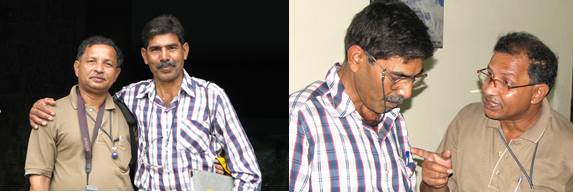
With my great friend Magan (Bissa) on 20.05.2008 at IMF, NewDelhi.
Swami Vivekananda most profoundly observed: “A deathless life is utterly meaningless. For death is inherent within the very flow of life. Within happiness lies sorrow embedded. This light is continuously burning away, and that precisely is its life. If you desire life, you must die for it at every single moment. Life and death are but two different manifestations of the same entity—viewed from different perspectives, they are merely the rise and fall of the exact same wave, and when merged together, they form one unbroken whole. One who looks at the fall becomes a pessimist; another who gazes upon the rise becomes an optimist.”
Alongside this, how can one ever forget that famous dialogue from William Shakespeare’s play Julius Caesar:
“Cowards die many times before their deaths;
The valiant never taste of death but once.”
The weak-willed perish every single day, while the courageous die but once. And ultimately, "জাতস্য হি ধ্রুবো মৃত্যুঃ" (Jatasya hi dhruvo mrityuh): This is a famous Sanskrit verse from the Bhagavad Gita (Chapter 2, Verse 27), which literally translates to "To be born is to eventually die"—is this not the absolute, immutable truth of this universe? Also, inspite of anything being described, realization says, “Beyond the technical triumphs and physical endurance lies a deeper truth: mountaineering is a spiritual journey”. The mountains test not only the body but the soul. They strip away illusion and leave only essence—the raw pulse of life. The majesty of the peaks is inseparable from the thought of death. To climb them is to embrace both peril and glory, to discover the profound truth of human endurance.
Postscript: It is worth mentioning that my original write-up on these reflections upon death was published in Bengali under the title “পর্বতে মৃত্যুভাবনা ও পর্বতের হাতছানি” — meaning “Thoughts of Death in the Mountains and the Call of the Summits” — in several Bengali magazines during 1984 and in the years thereafter. – Gautam Dutta
Related Articles


Place your ad here. Call +919163231788 or Contact Us


