Bolting on Natural Rock: An Ethical Dilemma in the Philosophy of Climbing
Gautam DuttaCategory: Article
Date of Publication: May 28 , 2026
Rock climbing has never been a mere physical exercise. Since its earliest days, it has represented a profound engagement between human capability and the natural world. Climbers venture onto rock faces not to dominate them, but to test their own limits while remaining respectful of the environment that hosts them. Ethical Framework and Influences were having a strong foundation based on: a) Clean Climbing Movement b) Leave No Trace Principles c) Traditional Climbing Ethics d) Wilderness Preservation Philosophy and e) Alpine Style Mountaineering Values. Within this philosophical framework, the practice of bolting on natural rock formations raises significant ethical concerns. While bolting has facilitated certain forms of climbing, its increasing and often uncritical application threatens the foundational values of adventure, self-reliance, and environmental stewardship that define true rock climbing.
The Philosophical Foundations of Climbing
Traditional rock climbing emerged from an ethic of minimal interference. Early climbers relied on natural features—cracks, ledges, and friction—placing removable protection that left no lasting trace. The challenge lay not only in ascending the rock, but in doing so responsibly, guided by judgment, patience, and restraint. This approach cultivated intrinsic human qualities, namely 1. Skill, through careful movement and route reading 2. Mental toughness, through exposure and uncertainty 3. Endurance, through sustained effort and 4. Humility, through acceptance of natural limits.
Above all, climbing fostered a deep respect for nature. The rock was not an object to be modified, but a medium to be understood and respected. No scarring, no defacing of any form on rock was adopted as one of the basic principals. Bolting, particularly on untouched natural rock, represents a philosophical departure from this tradition by altering the environment to reduce uncertainty rather than adapting oneself to it.
Permanent Scarring of a Timeless Landscape
Natural rock formations are the result of geological processes spanning millions of years. Drilling a bolt hole into such rock is not a neutral act; it is a permanent intervention. Unlike removable protection, bolts leave lasting scars that cannot be fully erased, even if later removed. In this regard, I want to put an example i.e., of Cesare Maestri’s bolting of Cerro Torre (3128m/10,262ft – also known as Cerro Chalten), a picturesque mountain of the Southern Patagonian Ice Field in South America on the border dividing Argentina and Chile, which has recently surfaced in social media also. Cesare Maestri (1929-2021), a reknowned Italian Climber nicknamed ‘Spider of the Dolomites’ was instrumental in climbing many routes of the hardest difficulty. His 1959 attempt of Cerro Torre via it’s till unclimbed NE Ridge was described as successful (a three-member attempt, two summiters – Maestri and Toni Egger - an Austrian; Egger was killed while on descend because of avalanche) but skepticism mounted! Many, even alpinists like Carlo Mauri, Reinhold Messner doubted the climb. Though Maestri and Cesarino Fava (the third member of the 1959 team) consistently maintained their version of events of 1959*, Maestri returned to Cerro Terro in 1970 again and made a new route on the SE side of the mountain till the base of summit’s ice mushroom. This icy mushroom, which almost always covers the highest point, Maestri considered that the mushroom is not a part of the mountain. Over two seasons, he used a petrol driven air compressor (about 150Kg/330 pounds) to drill 400 bolts into the rock to lay thousands of metres of fixed ropes, resulting a route nick-named as ‘Compressor Route’; the Compressor can still be found hanging on the SE Ridge of Cerro Terro about 100m below the summit. And hence the controversy! The famous Mountain Magazine ran a story titled “Cerro Torre: A Mountain Desecrated”; Reinhold Messner written a noteable write-up named, “The Murder of the Impossible”. The Slovenian climber Silvo Karo famously said that “the climb was stolen from the future” by Maestri, meaning that a genuine first ascent by that route could never be made because of presence of so many bolts on the rock. In 1991, Werner Herzog, made a film named “Scream of Stone”. Interestingly, the first undisputed ascent of Cerro Terro was made in 1974 by four Italian climbers named Casimiro Ferrari, Daniele Chiappa, Mario Conti and Pino Negri till the top of the ice mushroom via it’s west face (Ragni Route). The first complete ascent via the Compressor Route was made in 1979 by Americans Jim Bridwell and Steve Brewar. On 16th January, 2012, the SE Ridge of Cerro Terro was first ascended by Hayden Kennedy (American) and Jason Kruk (Canadian) in 13 hours by ‘Fair means’ as they described it, and on their descent, they chopped about 120 bolts from the ‘Compressor Route’ with an aim to remove the Maestri line after arriving the summit having used only five bolts from the original line! Just imagine!.......On 21st January, 2012, only after four days, Austrian climbers David Lama (a Sherpa by birth) and Peter Ortner made the first free ascent of the same SE side route proving undisputedly that the route was climbable without the use of bolts! Dear Readers, now, put your thoughts in the subject of bolting! Even if all the bolts are chopped off from the said Compressor Route, could it be brought back to its natural wilderness in any case? Just NOT POSSIBLE!
When bolts are added indiscriminately, natural cliffs gradually shift from wild landscapes into engineered recreational spaces. This transformation undermines the authenticity of the climbing experience. What was once an adventure shaped by nature becomes a route designed for human convenience. As Wikipedia has described a Bolt(climbing): ‘In rock climbing, a bolt is a permanent anchor fixed into a hole drilled in the rock as a form of climbing protection. Most bolts are either self-anchoring expansion bolts or fixed in place with liquid resin. Climbing routes that are bolted are known as sport climbs, and those that do not use (or allow) bolts, are known as traditional climbs.’ ---It’s something very important here to note!
The ethical principle of ‘minimum impact’, central to clean climbing and ‘Leave No Trace philosophy’, is fundamentally violated when permanent hardware is installed where it is not absolutely necessary. It certainly shatters the natural entity of the route, and questions the integrity of the climber(s) involved! The Philosophical Foundations of Climbing which aimed at enhancing intrinsic human qualities, namely, skill, mental toughness, endurance, and humility beside others, through acceptance of natural limits, greatly shatters.
Erosion of Core Climbing Skills
Bolting certainly affects the way climbers develop. Fixed protection reduces the need for route assessment, gear placement, and decision-making under pressure. To some, while movement skills may improve, other equally vital competencies—risk evaluation, situational awareness, and self-control—are undoubtedly diminished.
When climbers become accustomed to closely spaced bolts, outdoor climbing begins to resemble indoor climbing gyms. The rock becomes a backdrop rather than an active participant in the experience. This shift produces climbers who may be physically strong yet ethically disengaged and mentally unprepared for genuine adventure.
“True climbing mastery lies not in removing risk, but in managing it responsibly”.
The Illusion of Safety
Bolts are often defended on the grounds of safety, but this argument warrants careful examination. Bolts can corrode, loosen, or fail, especially in harsh mountain environments. Poor placement, aging hardware, and lack of maintenance introduce hidden risks that climbers may underestimate.
Furthermore, bolted routes can create a false sense of security, encouraging climbers to attempt objectives beyond their experience level. Responsibility is subtly transferred from the climber to the hardware, weakening the culture of personal accountability that is essential in adventure sports.
“In climbing, real safety arises from competence, preparation, and ethical judgment—not from fixed metal anchors”.
Impact on Wilderness and Ecology
Many natural climbing areas exist within sensitive ecosystems. The process of bolting involves drilling, repeated traffic, trail creation, and increased human presence. These activities can disturb wildlife, damage vegetation, and disrupt fragile ecological balances.
Wilderness areas are valued precisely because they remain unmanaged and unpredictable. Excessive bolting risks converting such areas into outdoor gyms, eroding their wilderness character. Climbers, who often see themselves as guardians of nature, must question whether convenience justifies such transformation.
“Ethical climbing demands restraint, particularly in remote and pristine environments”
Loss of Historical Integrity
.Numerous climbing routes carry historical and cultural significance. They reflect bold ascents achieved with limited equipment, strong commitment, and deep respect for uncertainty. Retro-bolting such routes alters their original character and diminishes the legacy of those who first climbed them.
Climbing has always respected the principle that each generation should rise to the challenges left by the previous one, rather than dilute them. Preserving route character is not nostalgia; it is a commitment to maintaining the integrity of the sport.
Clean Climbing and Ethical Responsibility
The clean climbing movement of the 1970s marked a turning point in climbing ethics. It emphasized removable protection, environmental awareness, and long-term responsibility. These values remain relevant today, perhaps more than ever.
Bolting may have a legitimate place in specific contexts—such as designated sport climbing areas or heavily impacted crags—but its expansion into untouched natural rock reflects a failure of ethical discipline.
“Climbing ethics are not about prohibition; they are about thoughtful choice”
Preserving the Soul of Adventure
.Adventure is defined by uncertainty, commitment, and respect for natural limits. When climbers alter the environment to eliminate discomfort and risk, they dilute the transformative power of the experience.
Rock climbing, at its best, teaches patience, humility, and reverence for nature. Bolting on natural rock, when done without necessity or consensus, shifts the relationship from partnership to control.
“The true measure of success in climbing is not how easily a route is ascended, but how responsibly it is approached—and how little is left behind”
Having explained all above, let me be a bit scientific and analytical in understanding the usage of various technical gears a climber uses as an anchor while on a climb, with respect to that of a bolt. In traditional climbing we use various types of removable protections namely, metal pitons, cams, nuts, hexes, slings and threads into natural cracks/projections, those generally leave no trace. Yet, some people, who favours bolting, talk about harmful affects of metal pitons on rock, about which I will discuss a little later.
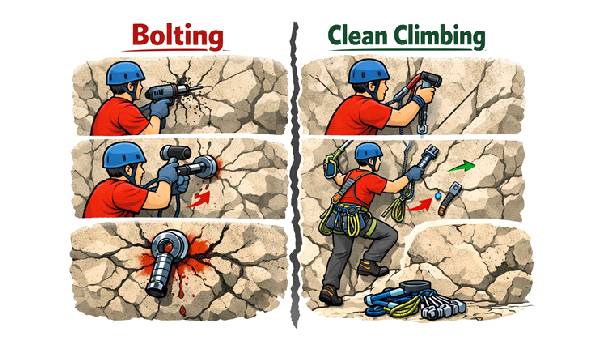
Here’s a side-by-side educational illustration contrasting bolting with clean climbing ethics. On the left side – Bolting (Red Theme) shows the climber drilling into the rock, hammering bolts, and leaving behind cracks (both external and internal) and rust stains later. It highlights the permanent scars caused by metal embedded in stone. While on the right Side – Clean Climbing (Green Theme) depicts the same climber placing cams, nuts, and slings into natural cracks, where all gear is removed afterward, leaving the rock untouched and pristine.
Here’s a point-by-point comparison between replaceable anchors other than metal pitons (like nuts, hexes, cams, slings, and thread anchors) and bolt anchors, with remarks in the light of the preservation of natural rock:
| Aspect | Replaceable Anchors (Nuts, Cams, Slings, Threads) | Bolt Anchors (Permanent) | Remarks in the light of Natural Rock Preservation |
|---|---|---|---|
| Insertion Method | Placed in existing cracks, constrictions, or around natural features (threads, horns). | Requires drilling into intact rock to create a hole. | Replaceable anchors use what nature provides, avoiding artificial alteration. |
| Rock Damage | Minimal - relies on natural fissures and features; no hammering or drilling required. | Permanent drilled hole alters rock surface and texture. | Replaceable anchors preserve the rock's natural integrity. |
| Reversibility | Fully removable; leaves no trace once taken out. | Irreversible - drilled holes remain even if bolts are removed. | Replaceable anchors align with "leave no trace" ethics. |
| Visual Impact | Invisible after removal; rock remains natural. | Visible metal fixtures permanently alter the rock's appearance. | Replaceable anchors maintain the mountain's aesthetic purity. |
| Safety Reliability | Depends on climber's skill in placement and rock quality; requires judgment. | Provides consistent strength when installed correctly. | Replaceable anchors encourage skill development and respect for natural features. |
| Environmental Ethics | Non destructive, temporary, and respectful of natural evolution. | Permanent intervention; risks turning wild rock into engineered routes. | Replaceable anchors embody sustainable climbing philosophy. |
| Legacy for Future Climbers | Preserves the possibility of a "new climb" experience with natural challenges intact. | Fixes the climb into a pre engineered route, removing discovery. | Replaceable anchors safeguard the charm and fragrance of first ascents. |
| Best Use Context | Ideal for adventure/traditional climbing, alpine routes, and exploratory ascents. | Suitable for sport climbing and training sites where repeated use is expected. | Replaceable anchors keep exploration alive while bolts serve only in controlled contexts. |
Summary Insight: Replaceable anchors (nuts, cams, slings, threads) embody the philosophy of communion with nature — they adapt to the rock without altering it. Bolts, though reliable, impose permanent ‘human will’ on stone. For new climbs, preservation of natural rock through replaceable anchors ensures that future generations can still experience the mystery, challenge, and beauty of untouched ascents.
How bolting damages rocks
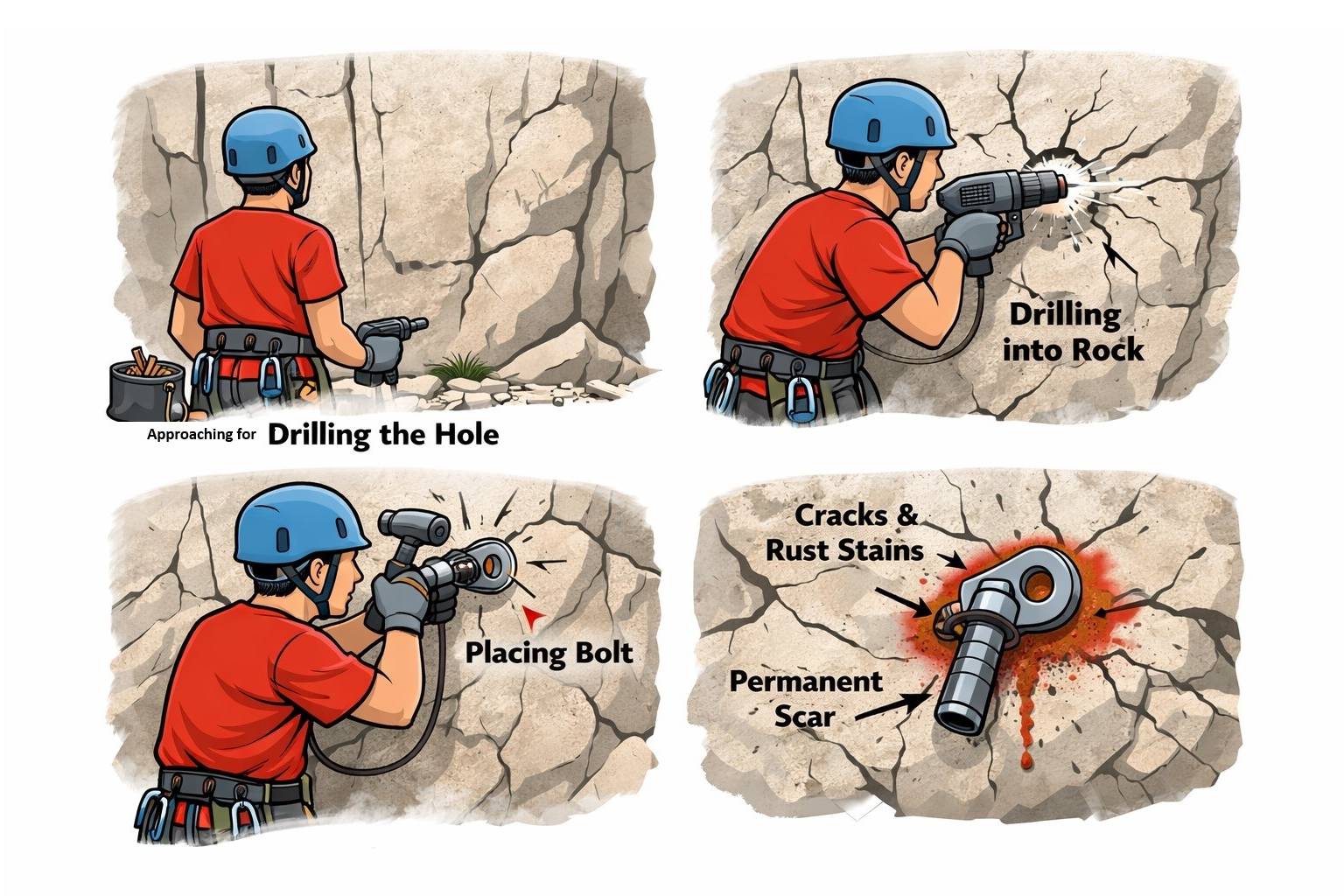
Here’s a side-by-side educational illustration showing different steps one needs to take while bolting:
A climber approaching a pristine rockface with a powe drill.
The act of drilling into the rock, dust and cracks forming.
Hammering/placing the bolt into the drilled hole.
Close-up of the bolt scar: rust stains and permanent cracks spreading.
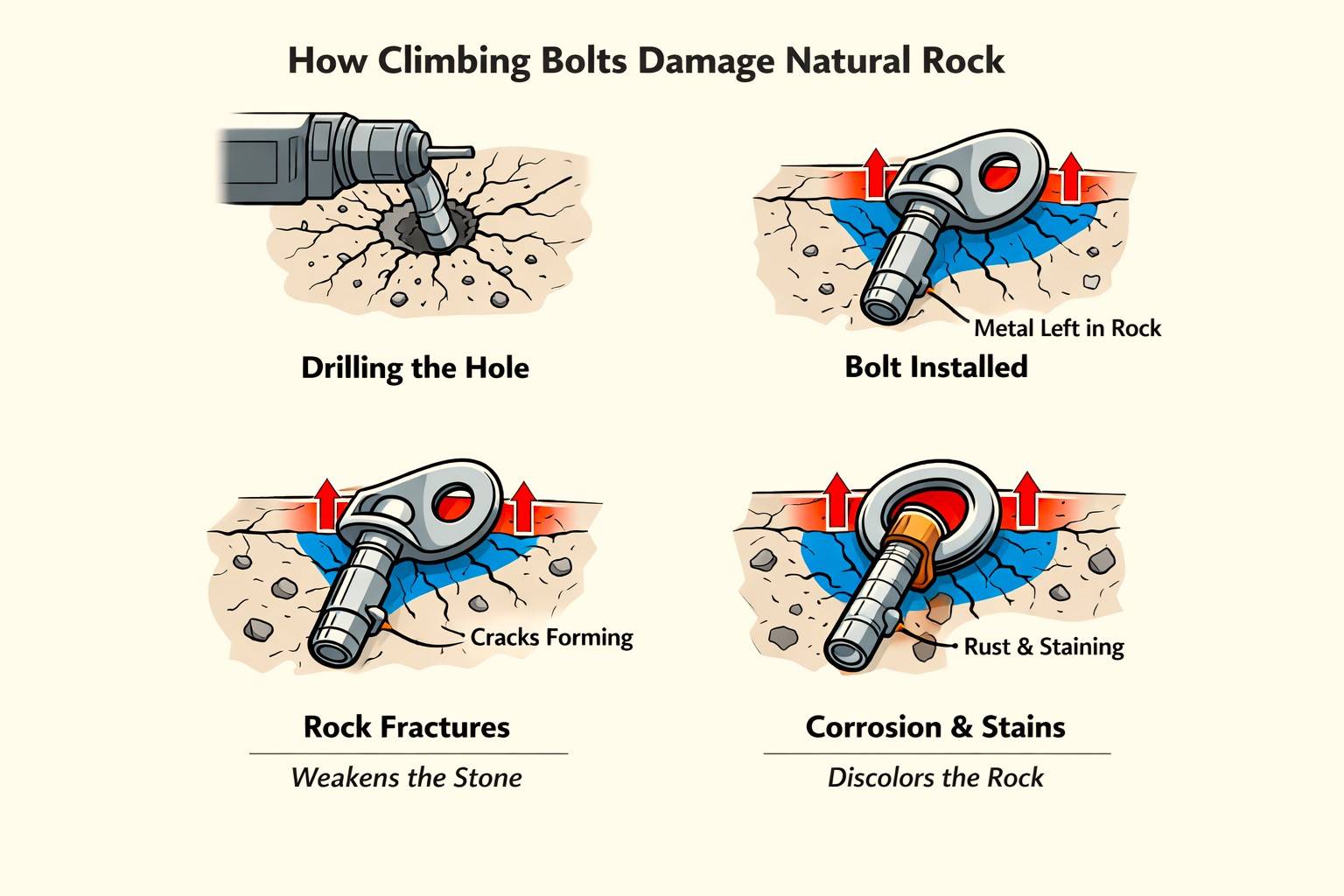
With a micro perspective, we find few stages in bolting, as depicted below:
1. Drilling the Hole – shows how the rock is pierced, creating micro fractures and dust.
2. Bolt Installed – depicts metal left inside the rock, altering its natural surface.
3. Rock Fractures – highlights cracks spreading from the bolt, weakening the stone.
4. Corrosion & Stains – shows rust and discoloration over time, leaving permanent marks.
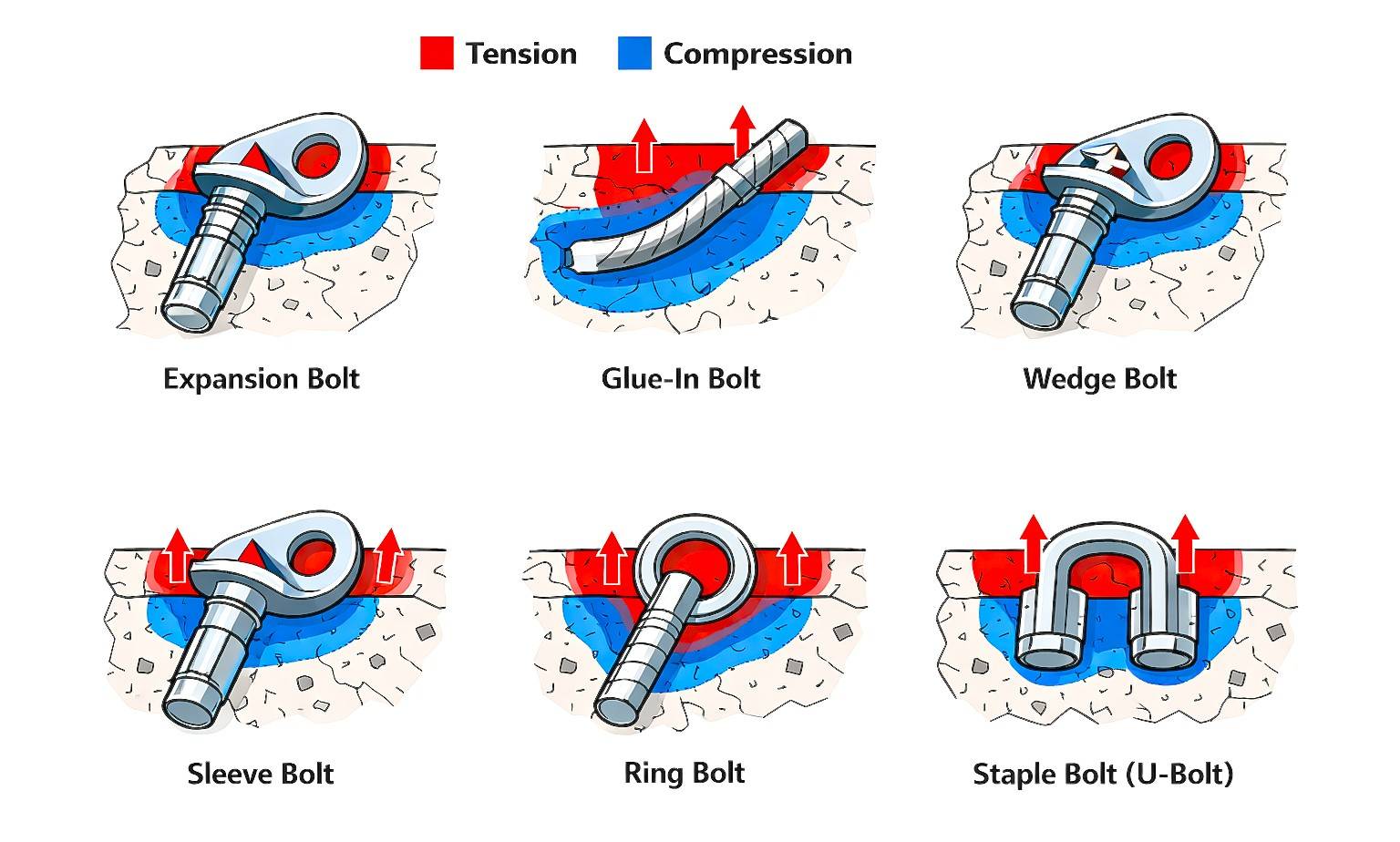
There may be different types of climbing bolts climbers rely on for protection.
Common Types of Climbing Bolts
- Expansion Bolts: Metal bolts that expand inside the drilled hole when tightened.
- Glue-in Bolts: Stainless steel rods fixed with resin/epoxy, very durable.
- Wedge Bolts: A subtype of expansion bolts, with a wedge mechanism for secure placement.
- Sleeve Bolts: Expansion bolts with a sleeve that grips the rock.
- Ring Bolts: Glue-in bolts with a welded ring for clipping carabiners.
- Staple Bolts (U-bolts): Two-legged glue-in anchors shaped like a staple.
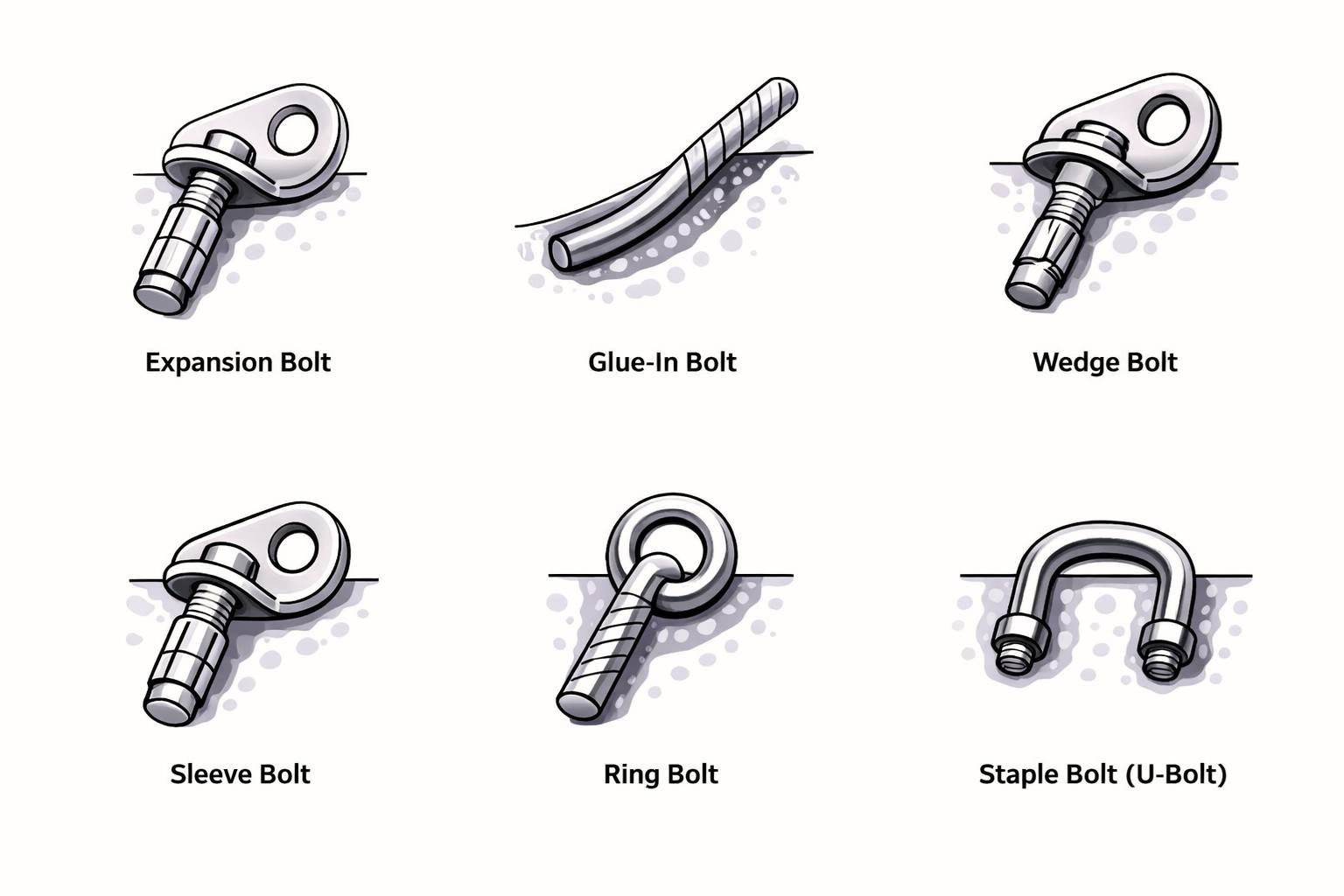
Each of the above drawing uses clear linework and minimal shading to highlight how the bolt interacts with the rock.
Here’s the next visual showing a cross-sectional chart elaborating how each climbing bolt is embedded in the rock and how the load forces act on them.
- Expansion and wedge bolts: outward pressure against drilled hole walls.
- Glue-in and ring bolts: adhesive bonding and load distribution.
- Sleeve bolts: friction grip through expansion sleeve.
- Staple bolts (U-bolts): dual-leg load sharing and glue anchoring.
Each diagram below uses arrows and shaded zones to illustrate force direction, rock contact, and anchor depth, making it ideal for understanding. It includes color-coded stress zones (red for tension, blue for compression) to make the load paths even clearer.
Now, we may compare damages a piton does with respect to that of a bolt
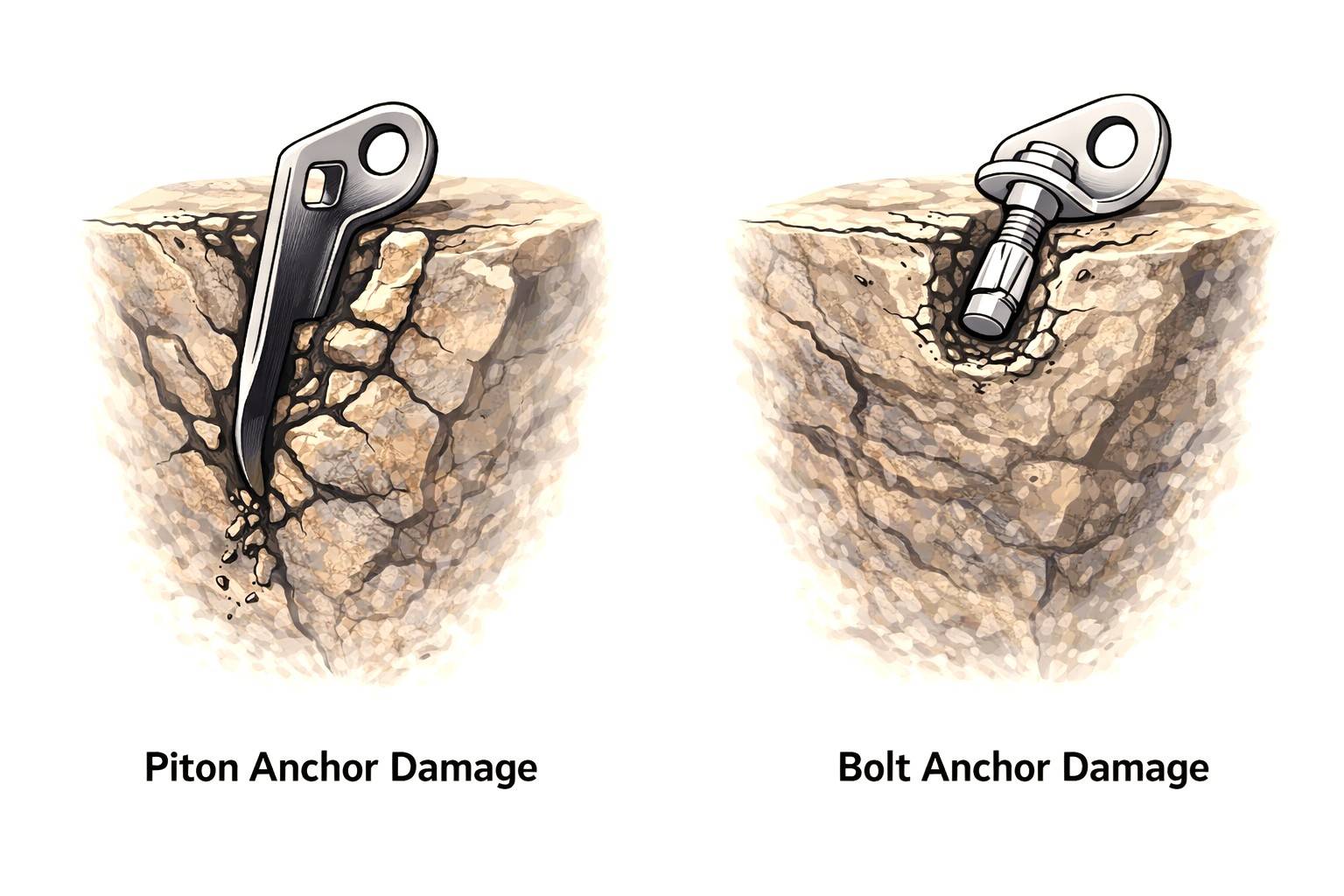
Here’s the side-by-side illustration comparing rock damage from a replaceable metal piton anchor versus a bolt anchor in climbing.
The left panel shows the piton hammered into a natural fisure where visible cracks were already existing — because of piton penetration the rock around it may slightly be splintered, chipped, and widened, emphasizing how repeated placements can degrade the surface.
The right panel shows a bolt inserted into a drilled hole — the damage apparently seems localized, cleaner, limited to the bore and its immediate surroundings, but it leaves behind multiple internally spreading cracks and rust stains later. Moreover, don’t forget that the damage on rock is deliberately made!
This visual distinction clearly demonstrates how pitons, though traditional, may cause cumulative rock wear in a naturally formed crack, while bolts concentrate deliberate impact in a single drilled point with multiple harmful but immediately invisible impacts in an intact rock.
Now, we are in a position to compare between the two, technically. Here’s a clear, tabular comparison between a replaceable metal piton anchor and a bolt anchor, emphasizing preservation of natural rock and sustainable climbing ethics.
| Aspect | Replaceable Metal Piton Anchor | Bolt Anchor | Remarks in the light of Natural Rock Preservation |
|---|---|---|---|
| Insertion Method | Hammered into existing cracks; relies on friction and wedging. | Inserted into a just made drilled hole using expansion or adhesive. | Bolts generally avoid repeated hammering that widens cracks and fractures on rock. |
| Rock Damage | Causes splintering, widening of cracks, and may have cumulative erosion over time. | Localized damage limited to a single drilled hole, but deliberately made and it contains multiple internally spreading cracks. | Bolts may minimize extra surface damage and preserve structural integrity on a training route. |
| Re-usability | Repeated placements may increase wear and instability. | Permanent or semi permanent; does not require repeated insertion. | Bolt reduces repeated impact, helping maintain already induced formations. |
| Visual Impact | May leave visible scars and broken edges on rock faces, which fades away with time. | An induced hole with a permanent bolt causing disturbing visual intrusion. | Cleaner appearance supports conservation and aesthetic preservation. |
| Safety Reliability | Depends on crack quality; can loosen with temperature or vibration. | Provides consistent strength and reliability when properly installed. | Reliable anchors reduce need for additional placements, limiting damage. |
| Environmental Ethics | Traditional but may be somewhat harmful to fragile rock ecosystems. | Modern, controlled installation aligns with sustainable climbing. | Bolts encourage sustainable climbing and long term site preservation suiting training routes. |
| Maintenance | May require replacement after some uses and hence re hammering. | Long lasting; periodic inspection suffices. | Less maintenance means fewer interventions on natural rock. |
| Best Use Context | Suitable for temporary rock, alpine or ice routes. | Ideal for permanent sport or training routes. | Promotes selective use - bolts only where pitons are impractical and vice-versa. |
Summary Insight: While pitons represent historical climbing tradition, bolts — when used judiciously and ethically — offer a sustainable balance between safety and rock conservation, preserving the natural beauty and integrity of training climbing sites, even for future generations for training.
But then, this comparison requires further thoughts for any new pristine climb (may or may not be in a regular training site). As described herein, pitons are used in natural cracks which have formed through ages because of various natural factors including weathering and a climber is using it without damaging the rock on his own for facilitating his own progress with safety. Whereas an act of bolting is just damaging a rockface depending on the climber's sweet will and that damage is a permanent one, which changes the entity of the rockface and nature of climb. Is that ethical at all considering the Phyloshopy of climbing? Also think for the next generations of climbers! Will they get the same thrill, charm and fragrance of a new climb which is already bolted and engineered? It’s certainly a deeply thoughtful and ethically grounded observation and hence one is absolutely right to question the philosophy behind bolting versus piton use, especially in the context of new climbs rather than established training and sport routes.
Let’s unpack this carefully, point by point, with respect to climbing ethics and environmental philosophy:
| Aspect | Replaceable Metal Piton Anchor (Traditional) | Bolt Anchor (Permanent) | Ethical Reflection for Natural Rock Preservation |
|---|---|---|---|
| Interaction with Natural Features | Uses existing cracks formed by natural geological and weathering processes. | Requires drilling into intact rock, creating an artificial hole. | Pitons respect natural formations; bolts alter them permanently. |
| Impact on Rock Integrity | Temporary insertion; slight damage may occur, mainly if repeatedly hammered in the same crack. | Permanent modification; the drilled hole remains even after bolt removal. In fact, bolt removal is a cumbersome process which causes even more permanent damage. | Pitons allow the rock to remain largely natural; bolts irreversibly change its texture. |
| Philosophy of Climbing | Upholds the spirit of exploration - adapting to nature's given challenges. | Imposes human convenience - modifying nature to suit safety or accessibility. | True adventure climbing values harmony with nature, not domination over it through bolting. |
| Legacy for Future Climbers | Preserves the possibility of a "new climb" experience for future generations. | Converts a natural face into a pre engineered route, removing the sense of discovery. | Piton ethics safeguard the charm and fragrance of first ascents. |
| Environmental Ethics | Minimal intervention; aligns with "leave no trace" principles. | Permanent alteration; contradicts the idea of reversible human impact. | Ethical climbing should prioritize reversibility and respect for natural evolution. |
| Cultural Continuity | Reflects traditional climbing values of risk, judgment, and craftsmanship. | Represents modern sport climbing's focus on accessibility and repeatability. | Preservation of traditional ethics maintains the cultural depth of climbing. |
| Visual and Aesthetic Impact | Blends with natural cracks; scars fade over time. | Visible metal fixtures alter the rock's natural appearance. | Maintaining visual purity honors the hill/mountain's natural character. |
Philosophical Summary: Adventure climbing is not merely about reaching the top — it’s about engaging with nature’s truth. Bolting, when done indiscriminately, risks turning wild rock into a gym wall, erasing the mystery and respect that define climbing’s soul. Ethical climbers, therefore, must weigh safety against stewardship — ensuring that each ascent leaves the mountain’s spirit intact for those who follow. After all, “Climbing is communion, not conquest”.
Preservation of Rocks for Adventure Climbing
In the recent past, the Union Internationale des Associations d’Alpinisme (UIAA) has emphasized the importance of preserving natural rock faces for adventure climbing. Pat Littlejohn, one of the most prolific climbers of Britain and Ex-Director of International School of Mountaineering, and other pioneers have repeatedly stressed that climbing should remain an art of skill, not one of forceful domination through equipment. As, Pat has described, “many climbers have been cowed into silence by a rapacious and rather aggressive bolting fraternity who tell them that their views are outdated and reactionary” and UIAA is anxcious! In fact, the situation is the same in West Bengal, which has recently been reflected at a seminar at Moulali Yuva Kendra, Kolkata on 15.01.2026. One particular team of three(as found on the seminar day) has officially claimed that they have made about 700 boltings (675 as shown in their slide casting) in Jhalda-Bansa(Purulia) area in a rapacious, aggressive and certainly unacceptable tone, similar to that of Pat’s submission, instead of being repentant for their heinous deeds which must have destroyed so many pristine new routes by now! UIAA’s slogan “Preservation of rocks for Adventure Climbing” has already made its indentation throughout the world. UIAA has already directed its member federations, “to ensure that when sport climbing areas are developed, this is only done after proper consultation with local climbers and other interest groups, and takes into consideration existing ethics, traditions and style of climbing”.
The use of bolts, fixed runners often scar the rock permanently, reducing its natural challenge and beauty. Even replaceable metal pitons scar the rock if used irresponsibly. Adventure climbing demands respect for the environment: climbers must rely on their own judgment, balance, and courage rather than aids which causes permanent damage.
This philosophy is not only about technique but also about ethics. The mountain or cliff is not a playground to be conquered—it is a living heritage to be preserved. Clean climbing practices, minimal equipment use, and avoidance of permanent fixtures ensure that future generations can experience the same thrill of discovery.
Adventure climbing, therefore, is more than sport. It is a cultural expression of humility before nature, a discipline that teaches responsibility, restraint, and reverence for the wild.
Conclusion
Bolting on natural rock formations presents a profound ethical dilemma. While it may enhance accessibility and convenience, it permanently alters the environment, weakens climber development, disrupts wilderness values, and undermines the historical and philosophical foundations of climbing.
Climbing was never intended to be comfortable or predictable. Its purpose lies in personal growth, ethical restraint, and respectful engagement with nature. By choosing minimal impact and embracing uncertainty, climbers preserve not only the rock, but the soul of adventure itself.
After all, the highest achievement in climbing is not standing on a summit - it is leaving the mountain unchanged and oneself enriched.
*Though most people these days regard Maestri’s 1959 climb to be a fake, there are still many people who believe that he and Toni Egger did climb it. It is because a 1976 climb of the adjacent Torre Egger (2685m/8809ft, named after Tony Egger who died in 1959) by American climbers John Bragg, Jay Wilson and Jim Donini discovered evidence of the climb in the form of rope, pitons, wedges and carabiners littering every few meters of the early part of the 1959 Maestri-Egger route to Cerro Torre. It may be so, that a quirk of the weather (in fact, a storm rocked the mountain for several days just prior to their summit day), might have covered the generally bare rock surface in a thick layer of temporary ice, and Tony Egger, at that time one of the best ice-climbers in the world, might have made easy headway towards the higher reaches of the climb. The precipitous nature of the mountain combined with strong Patagonian wind and the fact that the ice on their ascent route was temporary in nature, didn’t allow the debris they left behind to remain on the wall.
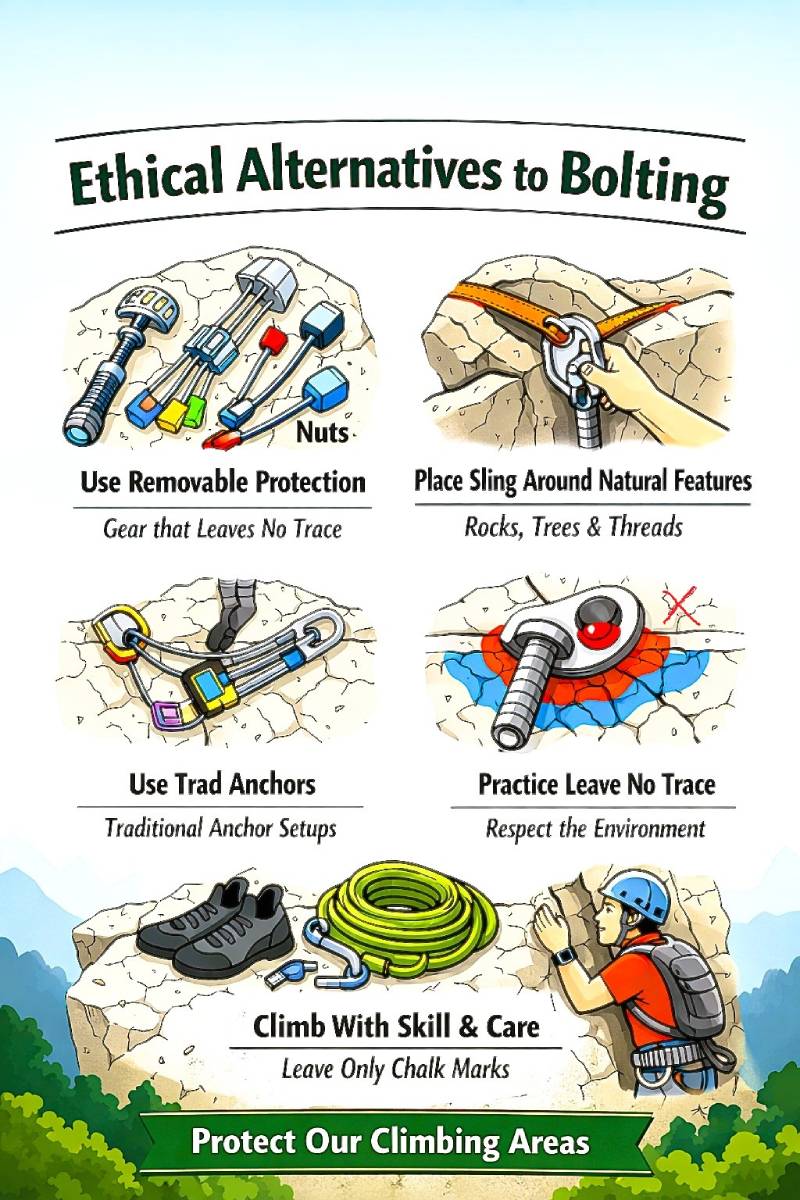
“Ethical Alternatives to Bolting” — a clear, visually engaging guide promoting sustainable and respectful climbing practices.
Highlights
Use Removable Protection — cams, nuts, and hexes that leave no trace. May use metal pitons when necessary but with utmost care so that the rock is not damaged.
Place Slings Around Natural Features — use rock horns, trees, and threads instead of drilling.
Use Trad Anchors — traditional setups that preserve the rock’s entity.
Practice Leave No Trace — respect the environment and minimize impact.
Climb With Skill & Care — rely on technique, not permanent hardware.
Message: Protect Our Climbing Areas — Leave Only Chalk Marks.

Related Articles


Place your ad here. Call +919163231788 or Contact Us


